

The EUDR for coffee importers has a catch almost nobody explains properly. You’re not penalised for buying coffee from deforested land. You’re penalised for not being able to prove you didn’t. The burden of proof is yours — and the coffee already sitting at the port won’t wait.
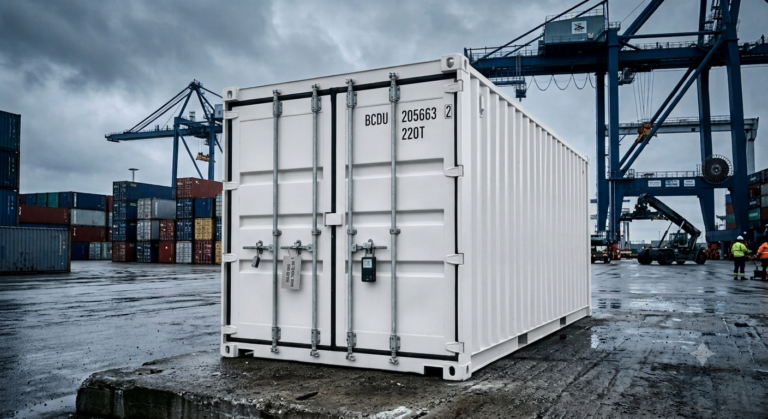
The EUDR for Coffee Importers Has a Firm Date (Again)
Let’s start with what generates the most confusion: the timeline.
Regulation (EU) 2023/1115 (EUDR) has been postponed twice. The first time, it was moved from December 2024 to December 2025. The second delays application to December 30, 2026, for medium and large enterprises, granting an additional six months for micro and small enterprises until June 2027.
This double delay led many in the industry to read it as “this is never going to happen.” However, co-legislators eliminated the grace period that the Commission had initially proposed for large and medium-sized companies. So, you are given more time up front, but once the date arrives, there is no safety net. Day one is day one.
And there is an even clearer signal. The simplification guidelines that the Commission was due to deliver before April 30, 2026, have already been published. The question that had been circulating among compliance teams for months was simple: Are they going to reopen the text? The Commission’s answer is no. The simplification confirmed that the timeline remains exactly as agreed in December 2025.
Translation for an importer or a roaster buying from origin: There are fewer than six months left, and there will be no more extensions.
The Question That Decides for You: Operator or Downstream?
Before talking about fines, this has to be settled:
-
Are you an Operator? You buy green coffee outside the EU and place it on the European market for the first time. This means you bear full due diligence obligations: collecting GPS coordinates of the farms, conducting a risk assessment, and submitting a Due Diligence Statement (DDS) into the TRACES NT system before your coffee passes customs.
-
Are you Downstream? You buy green coffee that has already been cleared and nationalized by a European importer. In this case, you normally do not submit your own declaration, but you must record and retain your supplier’s DDS reference number: that number is the proof that the obligation has been fulfilled for that specific batch.
This is what Regulation 2025/2650 changed: only the first operator placing the product on the EU market must submit the full declaration; subsequent operators can refer to that declaration and pass the information down the supply chain.
Now for the uncomfortable part. If you are a small roaster buying directly from a cooperative at origin, which is exactly what the specialty coffee sector has been celebrating as a virtue for a decade… You are the operator. The entire documentation burden is yours. Direct trade, which used to be a marketing argument, has just become a legal obligation.
What Happens If You Cannot Prove Compliance?
This is where the EUDR for coffee importers stops being paperwork and starts costing money. For legal entities, the maximum fine must be at least 4% of the operator’s or trader’s total annual turnover in the EU during the financial year before the sanctioning decision.
On top of that: confiscation of the goods and their derivatives, confiscation of the revenue earned on the transaction, temporary exclusion of up to 12 months from public procurement and public funding, and a temporary ban on placing the product on the market or exporting it. For serious or repeated infringements you also lose the right to use the simplified due diligence procedure.
Article 25.5 provides for the public naming and shaming of the sanctioned company. Member States will inform the Commission of final judgments against legal entities within 30 days, and the Commission will publish the name, date, a summary of the infringing activities, and the nature and amount of the penalty.
Think about what that means for a brand that sells transparency. A fine can be paid. Appearing in a public European registry of companies sanctioned for deforestation, while your website talks about honest relationships with producers, cannot be fixed with money.
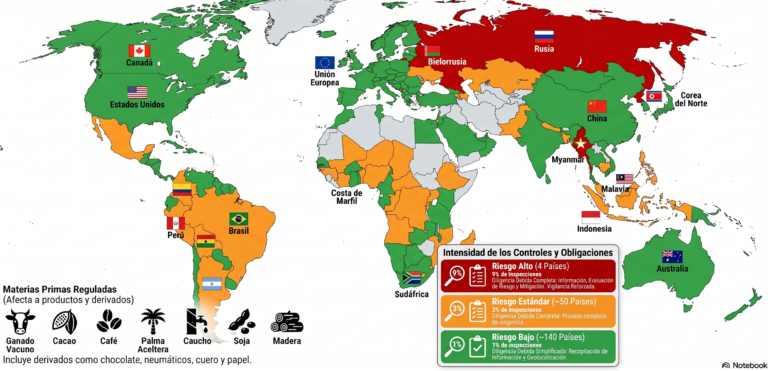
And what is the actual probability of being audited? Inspections are risk-based: competent authorities must inspect at least 1% of operators buying from low-risk countries, 3% for standard-risk, and 9% for high-risk.
Risk Beyond Countries
The plan B for many was to resort to simplified due diligence, but implementing Regulation (EU) 2025/1093 classifies countries by deforestation risk: only four are high-risk (Belarus, Myanmar, North Korea, Russia) and 140 are low-risk, including the entire EU, the US, the UK, and China. Coffee is not there. Colombia, Ethiopia, Mexico, Brazil, Indonesia, Peru: all are classified as standard-risk, making full due diligence mandatory.
For a small roaster, a 4% turnover fine sounds scary but abstract. This is concrete:
-
Without a valid Due Diligence Statement, the container does not clear customs. That coffee is your inventory for the quarter.
-
The money has already been paid to origin. The cash flow risk is entirely yours.
-
Your customers won’t wait. If you don’t deliver, they leave and won’t come back.
-
Responsibility cannot be outsourced.
Add to this Directive (UE) 2024/1203, which expands environmental crimes from 9 to 20. This means that an EUDR failure can escalate into a criminal offence depending on the country and the severity. It shouldn’t be overstated, but the direction is clear: this is moving from a sustainability to a legal risk for the importer.
The EUDR as an Opportunity
For twenty years, the coffee industry built certification seals o it wouldn’t have to look at the farm. Now, Europe demands what we have been saying here for a long time: a certification seal is not proof.
The real risk is that this cost gets entirely dumped onto the coffee farmer, and that “deforestation-free” coffee ends up being exclusive to large estates with the capacity to manage data.
We believe in the opposite: that data should be captured and owned by whoever is on the farm, not by whoever audits it later. We have already seen what happens when tools are designed without listening to the producer first.
Could you prove today which exact plot your last container came from? If the answer is no, that’s your starting point this season.
Sources Cited
Regulation (EU) 2023/1115 (EUDR base text) — https://eur-lex.europa.eu/eli/reg/2023/1115/oj
Regulation (EU) 2025/2650, of December 19, 2025 (second postponement; new “downstream operator” category; art. 34.1a simplification review) — via Taric: https://www.taric.es/noticias/2026-01-02-retraso-en-aplicacion-de-reglamento-eudr-hasta-el-30-12-2026/
Council of the EU, press release on the elimination of the grace period (Dec 4, 2025) — https://www.consilium.europa.eu/en/press/press-releases/2025/12/04/eu-deforestation-law-council-and-parliament-reach-a-deal-on-targeted-revision/
Report from the Commission to the Parliament and the Council on the EUDR, COM(2026) 191 final, May 4, 2026 (simplification review) — https://environment.ec.europa.eu/document/download/a3c5c3a0-232e-43c4-b0b8-1eecb1df45c7_en
Implementing Regulation (EU) 2025/1093, of May 22, 2025 (country benchmarking) — official list on Green Forum: https://green-forum.ec.europa.eu/nature-and-biodiversity/deforestation-regulation-implementation/eudr-cooperation-and-partnerships/country-classification-list_cs
Article 25 EUDR — penalties regime (4% EU turnover, product and revenue confiscation, 12-month exclusion, market ban, public naming) — analysis by Forest Policy: https://forestpolicy.org/policy-law/eu-regulation-deforestation-free-products-eudr and White & Case: https://www.whitecase.com/insight-alert/eu-adopts-new-rules-deforestation-free-products
Inspection rates 1% / 3% / 9% — Double Helix Tracking: https://www.doublehelixtracking.com/eudr-regulation-explained-what-changes-and-when/
Operator / downstream distinction for roasters — Coffee Lab: https://coffeelab.app/en/fuer-roestereien/eudr/ and EUDRReady: https://eudrready.eu/eudr-compliance-coffee-roasters-ireland/
Directive (EU) 2024/1203 on the protection of the environment through criminal law (transposition May 21, 2026) — https://eur-lex.europa.eu/eli/dir/2024/1203/oj/eng
SCA — “Cracking Coffee Regulation” (coffee traceability challenges under EUDR) — https://sca.coffee/sca-news/25/issue-22/cracking-coffee-regulation
Traceability you can actually verify.
We help European roasters meet the EUDR with real origin data, documented directly with the cooperative, without chasing exporters who never reply.