

Your coffee might be excellent, your price might be right, and your usual buyer might want to keep working with you. Even so, you could still find yourself shut out of the European market simply because you don’t have a file with your plot’s coordinates.
What the EUDR Means for Coffee Farmers, Without the Legal Jargon
Regulation (EU) 2023/1115, amended by Regulation (EU) 2025/2650 in December 2025, says something quite simple: starting December 30, 2026, no medium or large company can sell coffee in Europe without proving with geolocation data that this coffee does not come from land deforested after December 31, 2020. Micro and small enterprises have six more months, until June 2027.
Notice who is obligated: the European company, not you. The European Union is not fining you.
The one accountable to Europe is the operator: the company that places that coffee on the European market for the first time. It could be an importer in Hamburg or a small roaster buying directly. What they are risking is no small matter. The regulation mandates that the maximum fine must be at least 4% of their annual EU turnover, plus the confiscation of the coffee and the revenue generated from it, plus the public listing of their name as a sanctioned company.
In other words, your buyer is now risking their entire company over one of your lots. That is why they won’t wait until December 2026 to ask for your data. They will ask for it during the next harvest, and if you don’t have it, they will buy from someone who does. The pressure isn’t coming from Brussels; it’s coming from your exporter, and it is already arriving.
The 3 Things They Will Ask From You
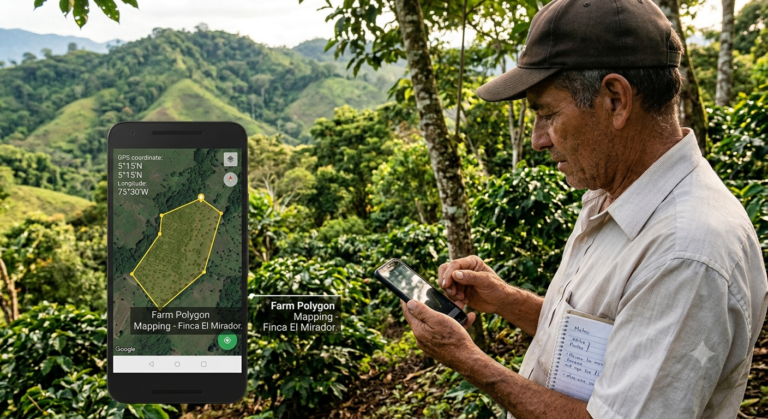
The map of your farm. If you own less than 4 hectares, a single GPS point is enough. If you own more, you need a polygon: walking the perimeter with your phone to map out the exact shape of your land. The coordinates require at least six decimal places, and the European system only accepts the GeoJSON format. There are free apps, like Survey123 or KoBoToolbox, that export this correctly. Pulling individual coordinates from Google Maps works for a single point, but it won’t generate a valid polygon. If you have more than 4 hectares, that method won’t work for you.
Your land papers. Title deeds, lease agreements, or whatever legally proves your right to work that plot, plus your registration as a producer.
Your production records. How much you harvested, from which plot, and on what date. Your delivery receipts are your best shield. Keep everything: documentation must be preserved for five years after that coffee reaches the European market.
The Real Problem Isn't You: It's the Collection Centers
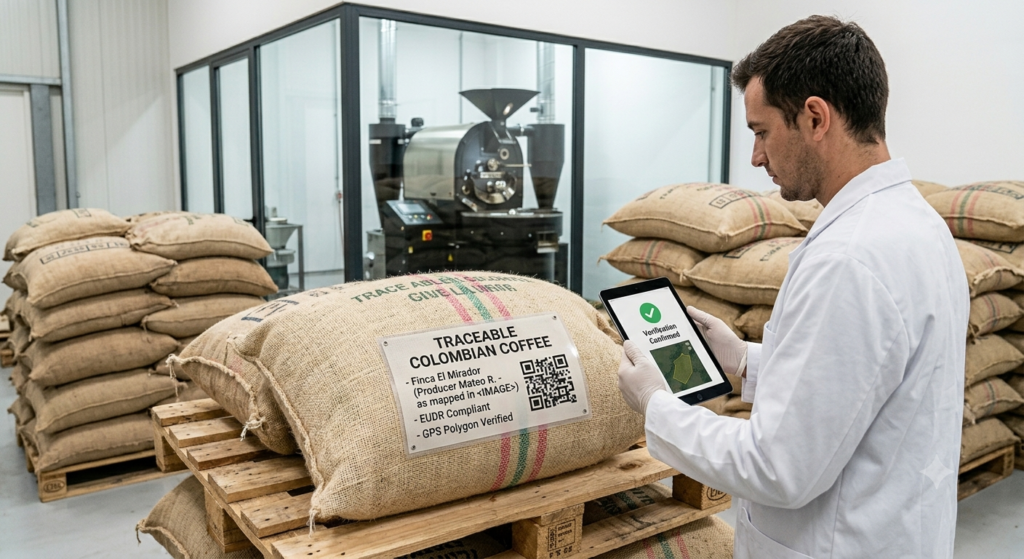
Europe strictly bans mass balance. In other words, it is no longer acceptable for a cooperative to pool coffee from sixty producers, mix everything into the same sack, and declare that “70% comes from verified farms.” Every single plot must be traced separately, or that entire lot cannot enter.
If you have spent your whole life delivering to a local collection center (acopio) that blends and homogenizes, which is exactly how a large part of smallholder coffee farming operates in Cauca and many other regions, the problem is not your farm. It is the entire architecture of the supply chain.
Furthermore, if your country’s laws prevent sharing geolocation data, that coffee simply cannot enter the European Union. There is no alternative document or exception.
That is why the real advice is not just “geolocate your farm.” It is: talk to your cooperative right now and ask how they plan to segregate the lots.
What No One Tells You: This Takes Real Work
This is where many articles tell you, “Your coffee is already sustainable, you just have to prove it.” That “just” hides a lot of effort.
Walking the perimeter of a farm takes hours. On steep slopes, under heavy shade, with a phone running out of battery halfway through. Multiply that by the scattered plots that almost every smallholder producer owns. It is real labor, and you are the one putting it in.
Don’t expect a shortcut just because you are a small producer, either. Europe classifies Colombia, Ethiopia, Mexico, Peru, and Brazil as standard-risk countries, which requires full due diligence. Only low-risk countries are exempt from assessing and mitigating risks—a list currently made up of EU Member States, the United States, the United Kingdom, China, and Japan.
That being said: the heavy lifting is done once, and after that, you will only need to update it.
What You Can Do This Week
Call your cooperative or exporter this week. Ask them one direct question: What do you need from me, in what format, and by when? If they don’t know how to answer, you have just discovered your real commercial risk.
Geolocate before the harvest, not during it. A single point is enough if you have less than 4 hectares; a polygon (at least 4 points) if you have more. Make sure to use an app that exports to GeoJSON.
Gather your papers into a folder. Physical or digital, it doesn’t matter, as long as it exists.
Demand that your name travels with the lot. If you are going to provide the data, ensure the coffee reaches Europe with your identity attached to it. That data belongs to you, and it has commercial value.
For twenty years, the sector built certification labels precisely to avoid having to look closely at the farm. Now Europe is saying what we have been saying here for a long time: a label is not proof.
Based on Regulation (EU) 2023/1115 of the European Parliament and of the Council, published on June 9, 2023.
Sources Cited
Regulation (EU) 2023/1115 — https://eur-lex.europa.eu/eli/reg/2023/1115/oj
Regulation (EU) 2025/2650, of December 19, 2025 (Deadlines: Dec 30, 2026 / June 30, 2027) — https://www.taric.es/noticias/2026-01-02-retraso-en-aplicacion-de-reglamento-eudr-hasta-el-30-12-2026/
Article 25 EUDR, Penalties (Minimum 4% of EU turnover, confiscation of product and revenues, public naming) — https://forestpolicy.org/policy-law/eu-regulation-deforestation-free-products-eudr and https://www.whitecase.com/insight-alert/eu-adopts-new-rules-deforestation-free-products
Geolocation Requirements (Point <4 ha, polygon >4 ha, six decimal places, GeoJSON, 5-year retention, ban on mass balance – European Commission FAQs 4th Edition) — https://farmerline.co/eudr-faq-deep-divegeolocation-traceability-and-the-end-of-mass-balance/
Implementing Regulation (EU) 2025/1093, Country Classification (May 22, 2025) — https://green-forum.ec.europa.eu/nature-and-biodiversity/deforestation-regulation-implementation/eudr-cooperation-and-partnerships/country-classification-list_cs
Commission Report COM(2026) 191 final, May 4, 2026, Simplification Review (Cost reduction from €8.1B → €2B) — https://environment.ec.europa.eu/document/download/a3c5c3a0-232e-43c4-b0b8-1eecb1df45c7_en
Inability to import if national law prohibits sharing geolocation (FAQ 4.9) — Same source as geolocation requirements.
You don't have to figure this out alone.
At A Coffee & A Story we help coffee farmers and cooperatives document their traceability the way Europe now requires: geolocation, harvest records, proof of origin, without the technical jargon or the cost of entry. Tell us about your farm and we’ll show you what the first step looks like.