

When asking who pays for EUDR compliance, there are three real figures we have gathered in recent months:
An Ethiopian producer with 150 hectares spread across several small farms: between $2,500 and $4,000 to comply, including approval from the national coffee authority and a week of fieldwork. Roughly $17–$27 per hectare.
A 7-hectare farm in Honduras: $22.50, including satellite deforestation analysis and an NGO subsidizing the training. About $3 per hectare.
A European direct-trade importer: €6,000, a one-time cost, to develop their own satellite monitoring algorithm covering fourteen origins. Cost per container: cents.
In the Global North, compliance is a one-off investment amortized over high volume. In origin countries, this EUDR compliance cost is a recurring expense per farm. No one has explicitly decided who absorbs it, but if you are a green coffee buyer, that decision rests on you in the coming months—whether you make it consciously or not.
Why Your Supplier Can’t Simply Raise the Green Coffee Price
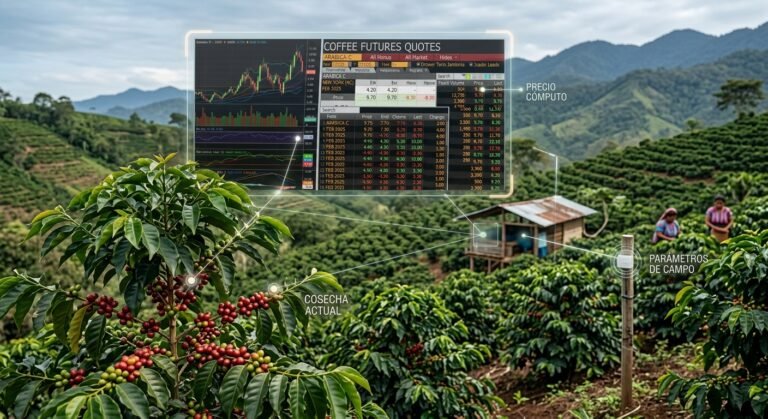
The benchmark price for Arabica is determined on the New York futures market (the C market). According to the Coffee Barometer 2026 (an independent biennial report monitoring the sector for twenty years), that price reflects supply imbalances, speculative capital, and transport costs—not the cost of producing coffee sustainably.
There is a second mechanism, documented since the collapse of the International Coffee Agreement in 1989: price transmission is structurally asymmetric. Farmgate prices rise slower than consumer prices and drop much faster. Producers absorb most of the volatility, while traders, roasters, and retailers capture steady margins during both booms and busts.
"But Coffee Is So Expensive Right Now"
In February 2025, Arabica reached $9.70 per kilogram ($4.40/lb on the New York futures market): the highest price ever recorded. The International Coffee Organization’s composite indicator reached $7.81/kg, also a record.
And yet, in eight out of the ten largest producing countries, the average coffee-farming household still failed to achieve a living income coffee farmer benchmark. The most severe gaps remain in Ethiopia and Uganda.
A smallholder farmer in Kenya with 0.7 hectares would need farmgate prices to rise approximately six times their 2020 levels to close that gap. Even then, nearly half of households would remain below the threshold because their yield volume is simply too small.
There is no price point at which your smallholder supplier can absorb an additional cost.
The Margin That No Longer Exists
Labor accounts for 40% to 60% of total production costs. However, standard accounting only tracks hired labor because it creates a cash outflow.
In Ethiopia, hired labor accounts for 76% of costs in garden coffee systems and up to 90% in forest systems. When family labor is valued at a living wage, total labor costs rise to 89% and 93%, respectively.
Apparent margins for smallholder coffee exist only because someone is working for free. That is where your EUDR compliance cost would have to come from if we assume it gets resolved solely at origin.
What Happens If Nobody Decides
Your supplier cannot raise prices enough to cover it. You likely do not want to squeeze your own margins: roasters have faced rising costs for two years alongside consumer resistance to higher cup prices.
The Coffee Barometer 2026 warns of something directly impacting your supply chain: origins lacking credible farm-level datasets risk exclusion—not because their coffee violates regulations, but because they cannot prove it complies. Access to the European market now depends as much on data infrastructure as on product quality.
Ethiopia and Uganda, where income gaps are among the most severe globally, are precisely the origins with the least data infrastructure.
If you do not decide who pays for EUDR compliance, the system will decide for you: your small supplier drops off your list, and you switch to buying from large farms with dedicated data teams because they can provide proof.
The real choices come down to three: absorb the cost yourself, pass it on to the end consumer, or stop buying from origins that cannot document their compliance.
The Price Is Documented or It Doesn't Exist
This is why we document the price paid, not just the origin.
A traceability sheet stating which plot the coffee came from without disclosing what the farmer was paid complies with the law, reassures the buyer, and changes nothing.
Recording the price does not redistribute power on its own, but an unmeasured asymmetry cannot be challenged. For twenty years, the industry built certifications precisely to avoid looking at that number.
If you are a green coffee buyer: do you know what the person who grew your coffee was paid? Not the FOB price you paid your exporter.
Sources
Coffee Barometer 2026 (primary source, PDF), Panhuysen & de Vries, Conservation International / Ethos Agriculture / Solidaridad, June 2026 — https://coffeebarometer.org/wp-content/uploads/2026/06/Coffee-Barometer-2026.pdf
p.10: Arabica $4.40/lb Feb 2025; I-CIP 354.52 ¢/lb; 22% drop by March 2026
p.11: prices driven by supply imbalances, speculative capital, and freight, not production costs; asymmetric price transmission
p.14: 8 out of 10 countries lack living income; Kenyan smallholder (0.7 ha) requires 6x 2020 prices
p.15: labor 40–60%; Ethiopia 76–90%, rising to 89–93% at living wage valuation
p.33: risk of exclusion for origins without farm-level data
Honduras Cost ($22.50 / 7 ha) — Mongabay via Daily Coffee News, Sandra Weiss, July 2026
European Importer Algorithm Cost (€6,000) — statements by Lennart Clerkx (This Side Up), Map It Forward podcast
Ethiopian Data ($2,500–$4,000 / 150 ha) — ACAS proprietary primary source, direct communication, August 2026. Anonymized.