

Coffee farmer data ownership begins with a visit: someone arrives at the farm with a smartphone and saves its coordinates. As of December 30, any coffee sold in the European Union must come from farms mapped this way. The regulation states what needs to be measured. Who owns the data… that is another story.
For Fredy Pastrana, and for most coffee farmers, it comes down to how much money they make for their crop.
Is it the farmer's?
Fredy Pastrana is a small, independent producer from Danlí, Honduras. When he asked how to comply with the EU Deforestation Regulation (EUDR), exporters offered to georeference his farm. In May, he told Mongabay what that actually entailed: exporters don’t use open platforms, they keep the data for themselves, and that makes it nearly impossible to switch to another buyer paying a better rate mid-harvest.
Without a farm map, his coffee cannot enter Europe. With the map locked in someone else’s system, his choices shrink to two: pay to remap the farm or keep selling to the same buyer. Being able to take their coffee elsewhere is almost the only leverage a smallholder has to negotiate. A retained map takes that leverage away.
This isn’t unique to small exporters. Becamo, which sells coffee from 9,800 Honduran farmers, uses a platform built by its largest client, the German group Neumann Kaffee Gruppe. A farm map in Honduras can easily end up living on a European buyer’s server. Meanwhile, the alternative of owning a proprietary traceability app costs up to $300 a month.
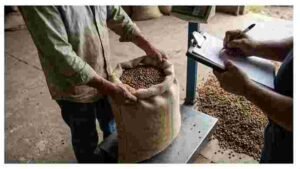
Is it the payer’s?
Europe has an answer for its own agricultural workers. In 2018, leading European agribusiness organizations (led by Copa-Cogeca) signed a voluntary Code of Conduct on Agricultural Data Sharing. Its core principle is clear: the data originator decides who accesses the data and how it is used through explicit consent, with full rights to data portability.
It sounds like a solution—until you read who counts as an “originator.” The Code defines it as whoever collects the data or whoever contracts its collection. If the technician walking the farm perimeter is paid by the exporter, the exporter can claim ownership of a map describing someone else’s land. Whoever funds compliance holds all the cards to keep the data.
Is it Europe's, since they require it?
The EUDR places the legal burden strictly on the operator: collect the farm’s geolocation, evaluate deforestation risk, and submit the due diligence statement. Who owns that data along the supply chain remains an open question, as Martin Greijmans from RECOFTC pointed out.
Europe knows what a neutral data intermediary should look like—it regulated them in the Data Governance Act, which mandates neutrality: intermediaries cannot use data passing through them for secondary commercial purposes and must act in the best interest of the data subjects. (In late 2025, the European Commission proposed integrating these rules into the Data Act, which remains in legislative processing).
Data control rules for its own farmers; neutrality standards for its intermediaries. Yet the regulation requiring maps from 12.5 million coffee-farming households outside the EU brings neither protection with it.
Does it belong to no one, then?
Pastrana suggested managing coffee farmer data through a public institution. Honduras tried this. The Honduran Coffee Institute (IHCAFE) launched an open-source app that generated 30,000 data points, but only 10% proved usable. A subsequent attempt at a shared platform failed: exporters refused to feed a system where competitors could see data they paid to gather, while doubting the institute’s cybersecurity.
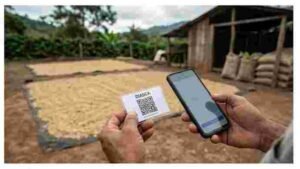
In western Honduras, project DIASCA tested a different path. Working alongside producers, mills, and partners like Becamo, they built an open-source infrastructure linked to the Linux Foundation’s AgStack registry. Every plot gets a unique ID, and farmers carry offline-capable QR code cards. In May 2025, a 20.7-tonne container of traceable coffee shipped out to Europe. Under this model, data control stays with the producer.
The core difference comes down to where the identifier lives: attached to the land, or locked to a vendor’s platform.
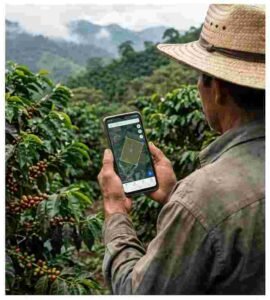
3 Questions to Test Coffee Farmer Data Ownership
If you buy green coffee, ask your supplier:
Where does the map live? On their platform, a client’s server, or a neutral registry?
Does the producer have a usable copy? In an open format like GeoJSON?
What happens if they switch buyers? If they have to remap the farm from scratch, they don’t own their data.
Our Take at A Coffee & A Story: The map belongs to the person who walks the land.
We believe coffee farmer data belongs to the producer, and we simply safeguard it on their behalf. It’s in our values and comes from what we write about technological sovereignty. The neutrality standard set by the Data Governance Act should apply to every intermediary, including us.
Sources
Fredy Pastrana, 98,000 registered coffee farmers, IHCAFE (30,000 data points, 10% usable, failed shared platform, institutional distrust) — Sandra Weiss, Mongabay, May 11, 2026: https://news.mongabay.com/2026/05/eu-deforestation-law-risks-leaving-honduran-coffee-farmers-behind/
Becamo, 9,800 producers, NKG platform; Matute statements — Daily Coffee News, July 22, 2026: https://dailycoffeenews.com/2026/07/22/eudr-provides-massive-challenge-to-the-vital-honduras-coffee-sector/
Private apps up to $300/month — Daily Coffee News / Mongabay, July 29, 2026: https://dailycoffeenews.com/2026/07/29/eudr-is-accelerating-farm-modernization-but-threats-to-smallholders-remain/
Code of Conduct: signatories, voluntary nature, data originator, explicit consent, portability — Full text: https://croplifeeurope.eu/wp-content/uploads/2021/03/EU_Code_of_conduct_on_agricultural_data_sharing_by_contractual_agreement_2020_ENGLISH.pdf · FEFAC: https://fefac.eu/resources/good-practices/eu-code-of-conduct-on-agricultural-data-sharing-by-contractual-agreement/
Data Governance Act: application from Sept 24, 2023, neutrality, data cooperatives, fiduciary duty — https://eur-lex.europa.eu/eli/reg/2022/868/oj
Proposal to repeal and integrate into the Data Act, COM(2025) 837 — European Parliament, Legislative Train: https://www.europarl.europa.eu/legislative-train/theme-a-new-plan-for-europe-s-sustainable-prosperity-and-competitiveness/file-digital-package
EUDR obligation on operator and open question on data ownership — Martin Greijmans (RECOFTC), Mongabay, Dec 30, 2025: https://news.mongabay.com/2025/12/se-asias-smallholders-struggling-to-meet-eudr-interview-with-recoftcs-martin-greijmans/
DIASCA: 20.7 t container, open infrastructure, AgStack — https://www.sustainable-supply-chains.org/news/a-shared-infrastructure-for-traceable-coffee-honduras-takes-a-bold-step-toward-eudr-compliance/
Plot identifiers, QR cards, offline apps — Alliance Bioversity-CIAT, April 2026: https://cgspace.cgiar.org/items/c24b2992-5d9f-4915-b4e6-b17e3d68549a
12.5 million coffee households — Coffee Barometer 2026: https://coffeebarometer.org/
You don't have to figure this out alone.
At A Coffee & A Story we help coffee farmers and cooperatives document their traceability the way Europe now requires: geolocation, harvest records, proof of origin, without the technical jargon or the cost of entry. Tell us about your farm and we’ll show you what the first step looks like.
Traceability you can actually verify.
We help European roasters meet the EUDR with real origin data, documented directly with the cooperative, without chasing exporters who never reply.